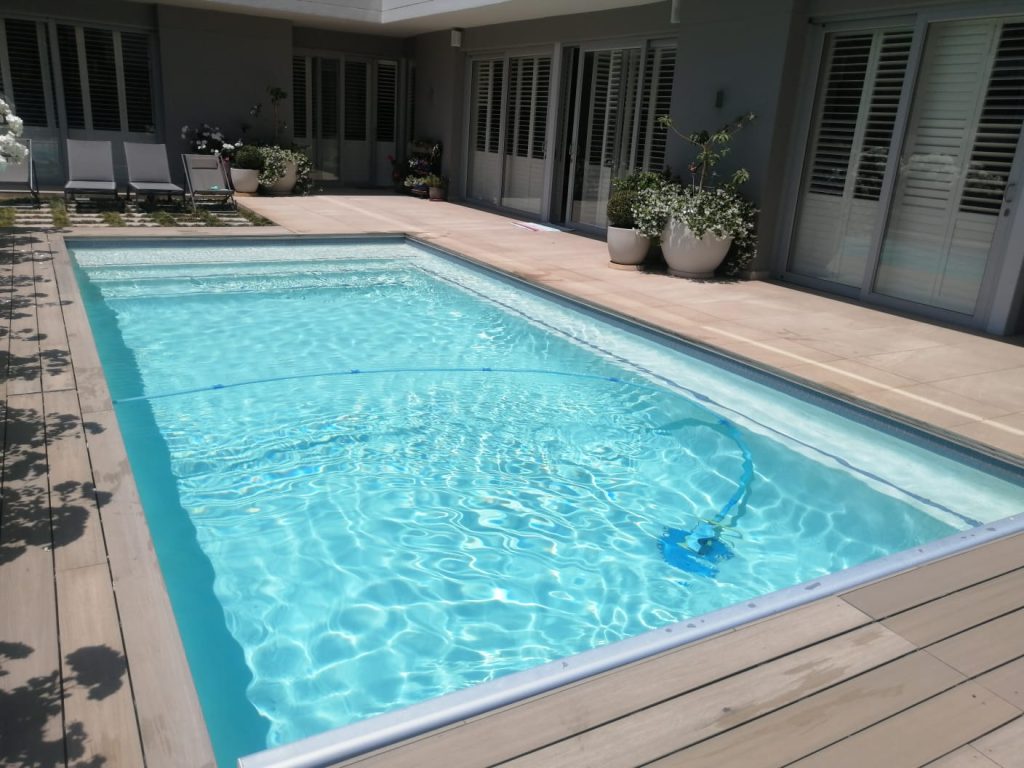
Summer in South Africa means more sun, more swimmers and more work for your pool. This guide walks you through what to do each day, each week and each month, what to check, what chemicals and equipment you need, and a basic troubleshooting section for common problems.
Quick-start checklist (print this and stick it near the pump)
- Skim surface: every day (or every time you use the pool)
- Empty skimmer & pump baskets: every 2–3 days (more if lots of debris)
- Check and record pH and free chlorine: daily or every second day in hot weather
- Run filter: at least 8–12 hours/day (longer in summer)
- Vacuum/brush and clean tiles: weekly
- Deep chemical test (pH, free chlorine, total alkalinity, stabiliser): weekly
- Shock (super-chlorinate) after heavy use or rain: weekly or as needed
1. Why summer is different
- Hotter water = faster chlorine loss, faster algae growth and more bather load.
- More rain/storms bring organic debris and can change water chemistry quickly.
- Run your system longer and test more often than in winter.
2. Equipment you’ll need (basic)
- Test kit (liquid DPD or reliable strips) that measures free chlorine and pH; a 4-way or 5-way test kit (free/total chlorine, pH, alkalinity, cyanuric acid) is ideal.
- Pool brush, telescopic pole, skimmer net.
- Vacuum head (manual or automatic) and hoses or a robotic cleaner.
- Leaf catcher or skimmer.
- Pool shock (chlorine granules or liquid), pH increaser (soda ash / sodium carbonate), pH decreaser (hydrochloric acid), alkalinity increaser (sodium bicarbonate).
- Safety gear: gloves, goggles, mask for mixing chemicals.
- A logbook or smartphone note to record readings.
Safety note: store chemicals in a cool, dry place away from children and pets. Never mix chemicals and always add chemical to water, not water to chemical.
3. Target water values (good summer targets)
- Free chlorine (FC): 1.0–3.0 ppm (mg/L) — aim for around 1.5–2.5 ppm on hot busy days.
- pH: 7.2–7.6 — ideal is ~7.4.
- Total alkalinity (TA): 80–120 ppm (helps keep pH stable).
- Cyanuric acid / stabiliser (if using stabilized chlorine): 30–50 ppm (keeps chlorine from breaking down in sun).
- Calcium hardness: depends on plaster/finish — typically 150–400 ppm for concrete pools; keep it stable to avoid scaling or erosion.
(If your pool uses a specialist finish like marbelite, follow your finish manufacturer’s recommended hardness range.)
4. Daily routine (5 minutes)
- Skim surface for leaves, insects, foam.
- Look at water clarity and colour. Note anything unusual.
- Check pump is running and filter pressure gauge: if pressure is 10–20% higher than normal, the filter likely needs cleaning. Change filter sand every 18-24 months for maximum efficiency and lower chemical usage.
- Check free chlorine and pH (quick strip test is fine daily). Record values.
5. Weekly routine (30–60 minutes)
Do this every week — more often during hot spells, heavy use or after storms.
A. Cleaning
- Brush pool walls, steps and tile line to prevent algae and scale.
- Vacuum the bottom.
- Empty skimmer and pump baskets; clean the pump lid O-ring if you see debris.
- Backwash sand filter once per week. If your filter has a pressure gauge you can backwash when pressure rises ~8–10 psi above clean baseline (or follow manufacturer guidance).
B. Water testing & balancing
- Do a full test: free chlorine, total chlorine (if available), pH, total alkalinity and stabiliser (cyanuric acid) monthly or if problems appear.
- Adjust in this order: alkalinity → pH → chlorine.
- If Total Alkalinity is low (<80 ppm): add Alkalinity Up (sodium bicarbonate).
- If Total Alkalinity is high: partially correct by lowering pH first (careful—do it slowly) or dilute with some fresh water.
- If pH is higher than 7.6: add pH decreaser (hydrochloric acid) slowly and retest after a few hours.
- If pH is lower than 7.2: add pH increaser (soda ash) slowly.
- Chlorine: keep free chlorine between 1–3 ppm. If it’s low, add appropriate dose of chlorine or shock.
C. Shock routine
- In summer, shock weekly (or after heavy swimmer load, rain, or algae). Use a chlorine shock product and follow product dosing. Run the filter for at least 8 hours after shocking.
D. Check equipment
- Inspect pump basket, seals, hoses for leaks or wear.
- Lubricate O-rings with pool-safe lubricant if needed.
- Check salt cell (if salt system): clean according to manufacturer and check cell hours.
6. Monthly tasks
- Test cyanuric acid (stabiliser) — if too high (>80 ppm) you’ll need to partially drain and top up with fresh water.
- Check calcium hardness and correct if drifting (dilute water or add hardness increaser as needed).
- Inspect pool finish, tiles and fittings for cracks or damage.
- Check automatic chlorinator or chemical feeders and clean/refill.
7. After heavy rain, a party or algae sighting
- After rain: test chlorine and pH immediately; top up chlorine and shock if needed. Clean skimmers and filters — storms load the system.
- After heavy use/party: shock the pool and run the filter longer (12–24 hours) to clear contaminants.
- If you see algae (green water or film): brush vigorously, check chlorine (often near zero), shock treatment (follow algicide/shock product instructions) and run filter continuously until clear.
8. Chemical basics — what to use when
- Daily/weekly sanitiser: chlorine (granular, liquid sodium hypochlorite or tablets). Keep free chlorine in range.
- Shock: stronger dose of chlorine to burn out combined chlorine and organics — granular cal-hypo or liquid shock.
- pH up / down: soda ash (increase), sodium bisulfate or muriatic acid (decrease).
- Alkalinity increaser: sodium bicarbonate.
- Algaecide: use as a complement after chlorination, not as a substitute.
- Clarifier: helps polish cloudy water (only after chemistry is balanced).
Always follow dosing instructions on the product — different strengths require different doses.
9. Energy & running-cost tips for South African summers
- Run filtration during the warmest part of day when swimmers use the pool most (but running at night can be cheaper if on time-of-use tariff). Aim 8–12 hours minimum in summer; longer when dirty or after events.
- Clean baskets frequently — a clogged basket reduces flow and costs pump energy.
- Consider variable speed pump: can save substantial electricity over the season by running at lower speeds longer.
10. Basic troubleshooting (fast reference)
Problem: Chlorine reading low every day
- Likely causes: high bather load, strong sun (low stabiliser levels), heavy rain, organic load, or filter not running enough.
- Fix: Shock pool, increase daily chlorine, test stabiliser and increase if too low, run filter longer.
Problem: Cloudy water
- Causes: poor filtration, high combined chlorine, low chlorine, fine particles.
- Fix: Test chemistry and balance, backwash/clean filter, add clarifier and run filter continuously until clear.
Problem: Algae (green/greenish water)
- Causes: low chlorine, poor circulation.
- Fix: Brush thoroughly, shock heavily, use algicide as instructed, run filter 24/7 until clear.
Problem: Foamy water or persistent surface film
- Causes: organic contamination (sunscreen, detergents) or pH out of range.
- Fix: Skim, clean skimmer, test pH and adjust, shock if necessary, use defoamer briefly.
Problem: High pH that won’t budge
- Causes: high alkalinity, continual addition of alkaline substances (source water).
- Fix: Lower alkalinity slowly, then pH. If source water is high, partial drain and refill may be needed.
Problem: High filter pressure after backwash
- Causes: clogged filter, compressed media, or stuck valve.
- Fix: Clean filter thoroughly, check pressure gauge, check for closed valves or blocked flow.
Problem: Salt chlorine generator not producing chlorine
- Causes: dirty cell, low salt, stuck relay, inadequate flow.
- Fix: Clean the cell per manufacturer, check salt level, ensure pump and flow, test cell output.
11. Common mistakes to avoid
- Don’t add different chemicals together — always add to water.
- Don’t assume brand A dose equals brand B dose. Read labels.
- Don’t let pH drift high — it reduces chlorine effectiveness.
- Don’t run the pump only for a short burst; consistent circulation prevents problems.
12. When to call a pro
- Persistent cloudiness or algae that won’t clear after 48 hours.
- Equipment failures (pump noise, leaks, burnt-out motor).
- Structural damage, cracks or large finish problems (e.g., marbelite finish peeling).
- If you’re unsure about chemical handling or complex balancing (especially if stabiliser or hardness extremes require partial drain).
13. Simple weekly timetable (example)
- Daily: skim, quick water check (pH & chlorine), check pump running.
- Mon: empty skimmer baskets.
- Wed: brush tiles/steps; check pump basket and clean.
- Fri: full chemical test and balance; shock if needed.
- Weekend: vacuum and inspect pool finish; backwash filter if needed.
Final tips — keep it easy
- Test more often in summer.
- Keep a small log of readings (date/time, pH, free chlorine, TA if tested). Trends tell you more than one reading.
- Be conservative with chemical storage — only buy what you’ll use in a season or store correctly.
- If in doubt, shock and filter. That usually gets you back on track fast.